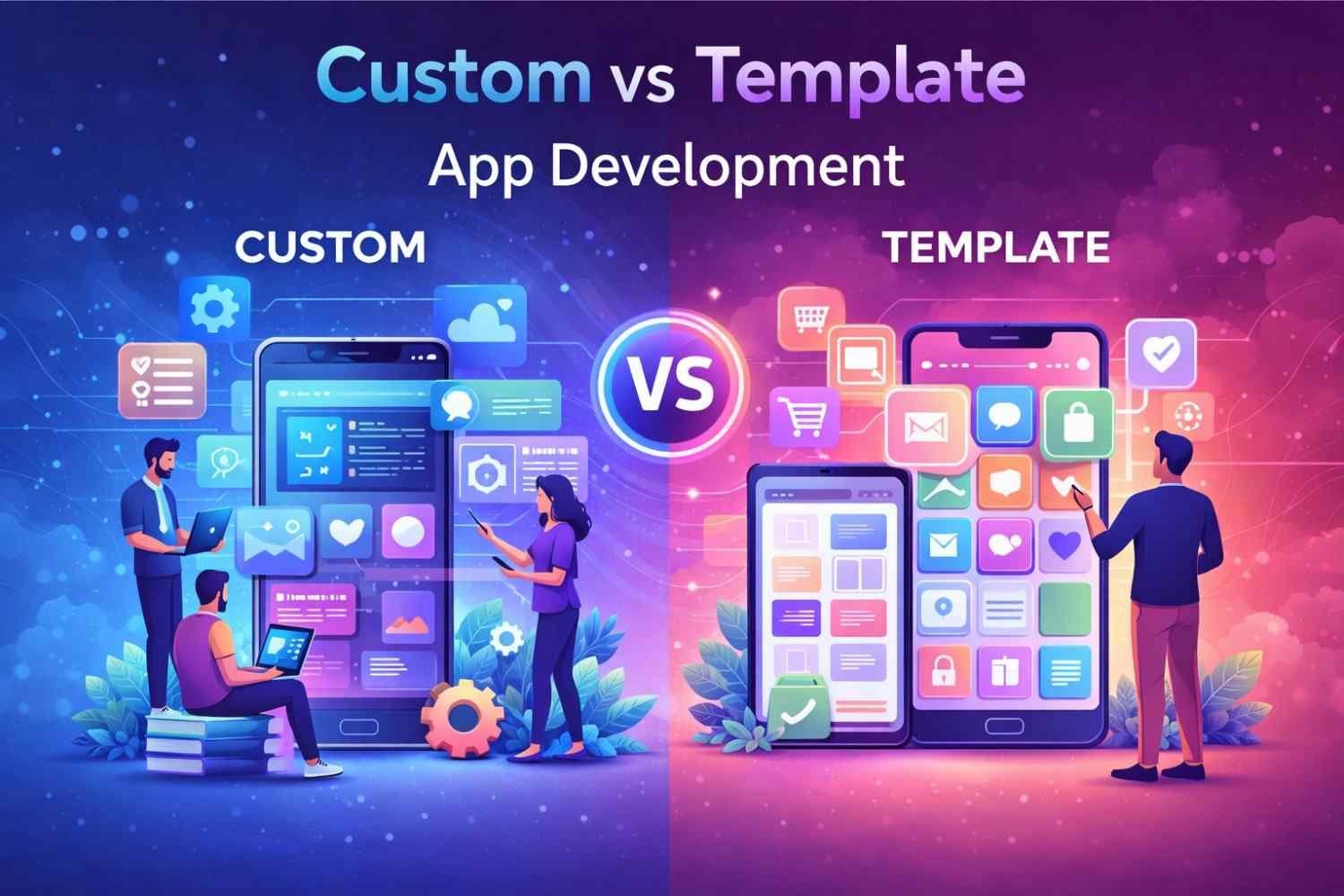
In today’s digital world, mobile applications play a crucial role in helping businesses connect with customers, improve services, and increase revenue. Whether you run a startup, a small business, or a large enterprise, having a mobile app can significantly enhance your brand presence and customer engagement.
However, one of the biggest decisions businesses face before developing an app is choosing between custom app development and template-based app development. Both approaches have their own advantages, limitations, and use cases.
Understanding the difference between these two methods can help you make the right choice for your business goals, budget, and long-term scalability. In this blog, we will explore Custom vs Template App Development, their benefits, limitations, and which option may be better depending on your business needs.
Understanding Custom App Development
Custom app development refers to building a mobile application from scratch based on specific business requirements. In this approach, developers design and develop the app’s features, user interface, and functionality entirely according to the client’s needs.
Unlike template-based apps, custom applications are unique and tailored to meet specific goals. Businesses can add advanced features, integrate third-party systems, and create a personalized user experience. Custom development gives businesses complete control over their application’s design and functionality.
Key Characteristics of Custom App Development
Fully customized features
Unique design and user interface
High scalability and flexibility
Integration with existing business systems
Strong security and performance optimization
Understanding Template App Development
Template app development involves using pre-designed frameworks or ready-made app templates to build a mobile application quickly. These templates usually come with predefined layouts, features, and functionalities.
Instead of building everything from scratch, developers modify existing templates to meet basic business requirements. Template apps are often used by small businesses or startups that need a quick and affordable solution.
Key Characteristics of Template App Development
Pre-built design and features
Faster development time
Lower development costs
Limited customization options
Basic functionality suitable for simple apps
Custom vs Template App Development: Key Differences
Understanding the differences between custom and template-based development can help businesses choose the right approach.
Both approaches serve different business needs depending on the project scope and budget.
Advantages of Custom App Development
Custom development is often the preferred choice for businesses looking for long-term digital growth. Let’s explore the major benefits.
1. Tailored to Business Needs
Custom applications are designed specifically for your business operations and objectives. Every feature and function is developed to support your unique workflows.
This means you are not limited by pre-built functionalities and can add features that give your business a competitive edge.
2. Greater Flexibility and Scalability
One of the biggest advantages of custom development is scalability. As your business grows, your mobile app can evolve with new features, integrations, and functionalities. This flexibility ensures your application remains relevant for years.
Custom apps can easily adapt to:
Increasing user base
New technologies
Business expansion
Additional services or products
3. Enhanced User Experience
User experience is critical for app success. Custom development allows designers to create unique interfaces that match your brand identity and user expectations. A well-designed custom app helps improve user engagement and retention.
Benefits include:
Intuitive navigation
Personalized user journeys
Unique design elements
Better performance optimization
4. Better Security
Security is a major concern in mobile app development, especially for applications handling sensitive data such as financial information or personal details.
Custom apps can be built with advanced security protocols and tailored protection mechanisms that reduce vulnerabilities and protect user data.
5. Seamless Integration with Business Systems
Many businesses rely on existing software systems such as CRM, ERP, payment gateways, or inventory management tools.
Custom applications can easily integrate with these systems to ensure smooth data flow and improved operational efficiency.
Advantages of Template App Development
While custom development offers many advantages, template-based development also has certain benefits, especially for small businesses and startups.
1. Faster Development Process
Template-based apps can be built much faster because developers use pre-built structures instead of creating everything from scratch.
This makes it ideal for businesses that want to launch an app quickly.
2. Lower Development Costs
Since templates reduce development time and complexity, the overall project cost is significantly lower.
This makes template development suitable for startups or businesses with limited budgets.
3. Simpler Development Process
Using pre-designed templates simplifies the development process. Developers only need to customize certain aspects such as branding, colors, and basic functionality.
This approach reduces technical complexity and allows faster deployment.
Limitations of Template App Development
Although template apps offer cost and speed advantages, they also come with certain limitations.
Limited Customization
Templates restrict design and functionality options, which may prevent businesses from creating unique user experiences.
Generic User Interface
Since templates are used by multiple businesses, the app design may look similar to other apps in the market.
Limited Scalability
Template apps may struggle to support advanced features or high user traffic as your business grows.
Performance Constraints
Pre-built frameworks sometimes include unnecessary code that can affect app performance and speed.
When Should You Choose Custom App Development?
Large businesses and growing startups often choose custom development because it offers greater control and flexibility. Custom development is the better choice when:
Your business requires unique features
You want a fully customized user experience
Your app needs to integrate with existing systems
You expect high scalability and long-term growth
Security and performance are top priorities
When Should You Choose Template App Development?
Startups sometimes begin with template apps to validate their concept before investing in full-scale custom development. Template-based development may be suitable when:
You have a limited budget
You need to launch an app quickly
Your app requires only basic functionality
You are testing a business idea or MVP
Hybrid Approach: The Best of Both Worlds
In some cases, businesses choose a hybrid approach where developers start with a basic framework and then customize it extensively.
This method allows companies to reduce development time while still adding unique features and design elements.
However, for applications that require advanced capabilities, custom development still provides the best long-term value.
Factors to Consider Before Choosing
Before deciding between custom and template development, businesses should evaluate several factors.
Budget
Template apps are cheaper initially, while custom apps require higher investment but provide long-term value.
Project Complexity
Apps with complex features require custom development.
Time to Market
If speed is critical, template apps may be a good starting point.
Scalability
Businesses planning long-term growth should prioritize scalable custom solutions.
Future of Mobile App Development
These technologies often require advanced customization and integration, which makes custom app development increasingly important.
Businesses aiming to remain competitive in the digital landscape should consider scalable and future-ready development strategies. The mobile app industry continues to evolve rapidly with new technologies such as:
Artificial Intelligence
Machine Learning
Augmented Reality
Internet of Things (IoT)
Cloud computing
Conclusion
Choosing between Custom vs Template App Development depends largely on your business goals, budget, and long-term vision. Template apps offer a quick and affordable way to launch basic applications, making them suitable for startups and small projects.
However, custom app development provides greater flexibility, scalability, security, and unique user experiences. For businesses that want to build powerful applications capable of supporting growth and innovation, custom development is often the better investment.
As the demand for advanced mobile applications continues to grow, working with experienced development professionals becomes essential. A reliable development partner like Xoviontech can help businesses create scalable, secure, and feature-rich mobile applications tailored to their specific requirements and long-term success.